Project update 21, publication update 19: Project Pteropus delivers results!

Sheema completed her PhD in Ecology last November, when she successfully defended her thesis at the Jardin des Plantes in Paris. Now comes the good part: sharing the results, data and information from her research! We’re happy to announce that 2 new papers from her thesis just got published this month.

Fruit bats are important ecosystem service providers, pollinating flowers and dispersing seeds over long distances. Instead of protecting these useful flying mammals however, humans are threatening their survival through hunting and persecution.

Finding out what flying foxes eat is a first step towards discovering what flowers they pollinate and what seeds they disperse. This will help strengthen the cause to promote their protection. Project Pteropus started investigating this question in 2015, and now, the results of the analysis are finally out! We’ve made a first start towards answering the question of ‘What do the Tioman Island flying foxes eat?’

Identifying flying fox food plants by collecting and analysing droppings
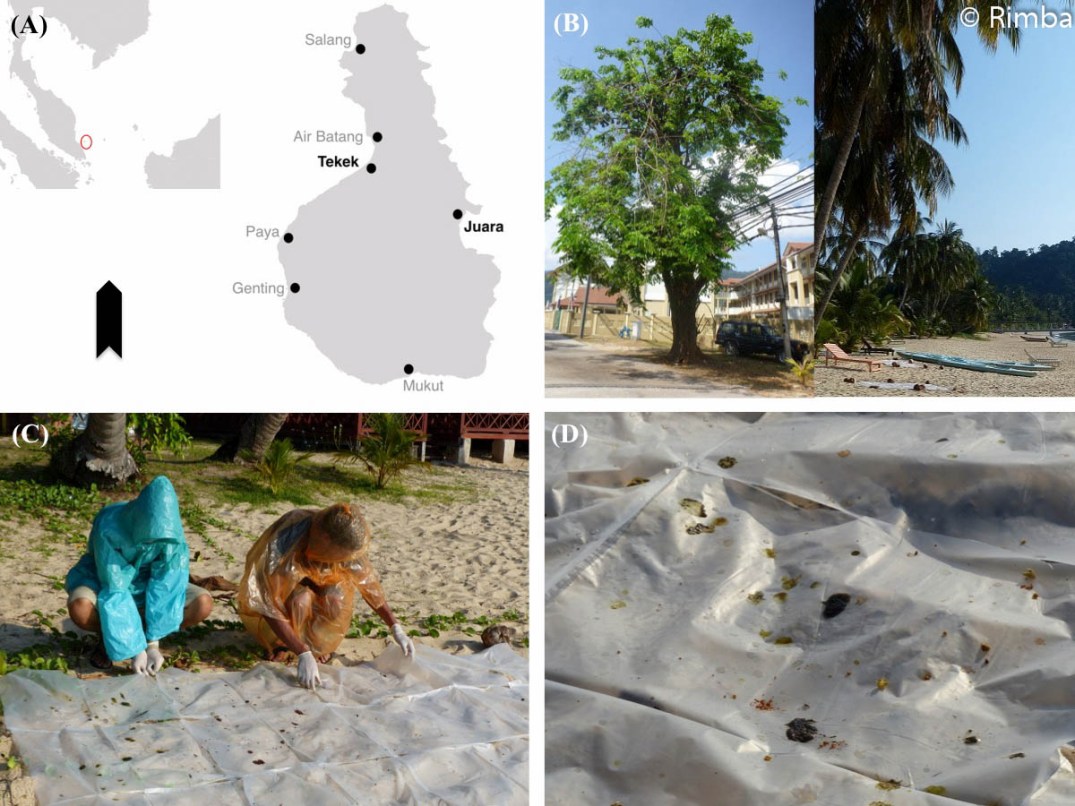
PeerJ image Continue reading

Toolbox update 7: How to use Peninsular Malaysia’s first online map of limestone hills

For many years, scientists in Project Limestone have been frustrated by the lack of GIS information on limestone hills in Malaysia.  Till now, information on localities, shapes and sizes could only be obtained from books and journals, but not anymore…

Thanks to Liew and the team, Rimba has created Peninsular Malaysia’s first online map containing 445 hills.  This GIS map can easily be accessed by anyone who has Google Earth. This map is not a final product, but can be constantly improved by anyone who wants to add spatial or biological information on limestone hills. All the methods and data are available for anyone to reuse, revise, remix and redistribute.

With this map, we were finally able to conduct a simple conservation prioritisation exercise for limestone hills based on their size and the degree to which they are isolated and disturbed.

You can find our paper published here in the journal Tropical Conservation Science. Meanwhile, here are videos that explain the methodology, and how to update and use this map!