Publication update 13: Another new snail species from Terengganu!

It’s always a treat to find a species new to science.

But finding a new species of snail from Terengganu isn’t surprising.

One reason is that before the second half of the last century,  malacologists (scientists who study snails) mainly looked for snails in the Federated Malay States, which consisted of Negri Sembilan, Pahang, Perak and Selangor.

Finding a new species in Malaysia also isn’t that surprising. According to a study by Giam, one of Rimba’s researchers, tropical moist forests of the Neotropics, Afrotropics, and Indomalaya (this includes Malaysia!) are likely to harbour the greatest numbers of undescribed species.

Just last year, Reuben and his colleague, Tan Siong Kiat, described a new genus and species of snail in Terengganu. This snail is now known as Kenyirus sodhii. That was the first snail ever described from Terengganu and one of the first few animals to be named after Kenyir.

Now Reuben and another colleague, Mohammad Effendi bin Marzuki, are proud to announce another new species of snail from Terengganu: Pearsonia tembatensis.
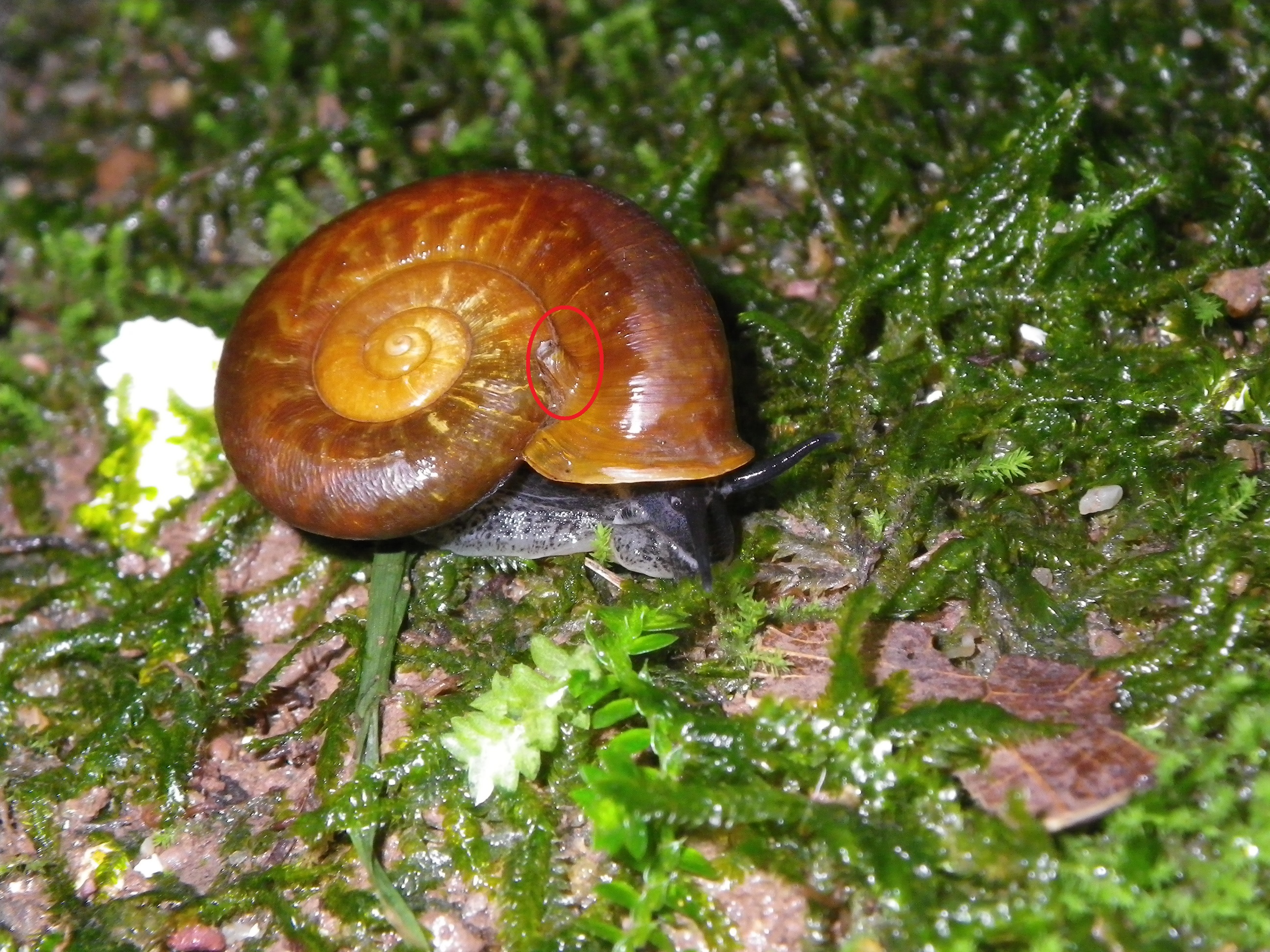
Pearsonia tembatensis, new species, from Tembat Forest Reserve, Terengganu. Red circle indicates snorkel.

Just for the record, this is the first time scientists have found this genus (Pearsonia) in Malaysia! You can read more information on this discovery here, which was published in the recent issue of the journal Raffles Bulletin of Zoology.

If you look closely at the shell of this snail, you will notice a snorkel-like protuberance (circled in red) on the shell. For now, nobody knows yet what the function of this ‘snorkel’ is for.

You might find the name tembatensis familiar, as this snail was named after Tembat Forest Reserve, where Reuben conducted his camera trapping work under the Kenyir Wildlife Corridor Project.

The snail was also named after Tembat to highlight the environmental destruction befalling this forest reserve due to the construction of  new hydroelectric dams. We hope that we’ll still be able to find this snail in drier parts of the forest once the dam begins operating, because in the flooded areas, even its snorkel won’t be able to keep this air breather alive for long…
Publication update 12: Indigenous rights matter!

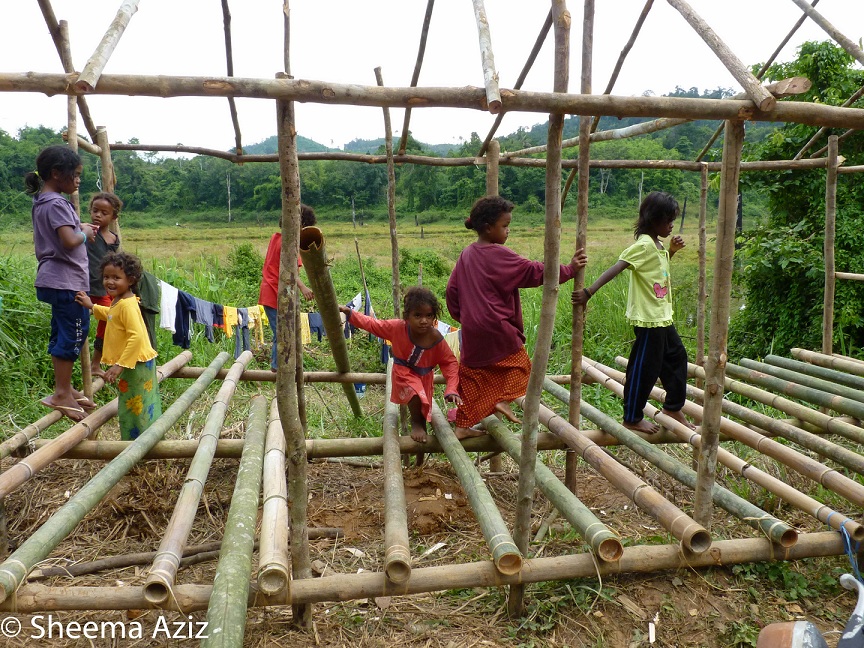
Temiar children playing in RPS Banun, an Orang Asli resettlement in the Belum-Temengor Forest Complex.
Temiar children playing in RPS Banun, an Orang Asli resettlement scheme in the Belum-Temengor Forest Complex.

There was a time when people used to think that saving the environment was all about – well, the environment. Some people even confused it with ‘saving the trees’, ‘saving the animals’, or ‘saving wildlife’. Many conservationists nowadays know better. We’ve learnt that the environment has been shaped and nurtured by the many indigenous and local people who revere it, care for it and ultimately depend on its resources for their survival. Focusing on saving the environment, or wildlife, alone is meaningless if we don’t take into account the forest-dependent or sea-dependent peoples who are critical in ensuring nature’s well-being – and for whom, in turn, nature is a critical part of their lives. Sometimes they can be a part of the problem, but often they can be part of the solution too. This is why more conservationists need to start recognising the important role played by indigenous peoples in conservation, and also start considering and incorporating indigenous peoples in conservation efforts. Continue reading

Publication update 11: All about tapirs

tapir

Reuben’s and Sheema’s latest publications are all about the Asian Tapir (Tapirus indicus). Compared to its New World counterparts, the only tapir species to be found in the Old World is relatively poorly studied. Despite its striking appearance, its distribution in Peninsular Malaysia is still largely based on guesswork rather than in-depth, long-term research. Scientists have also been unable to get an accurate idea of its population size.

These two papers published in Integrative Zoology aren’t part of Rimba’s work though; they’re the product of a research collaboration led by WWF-Malaysia that is the first attempt in the country to identify tapir individuals based on their specific black-and-white markings. Continue reading