Publication update 11: All about tapirs

tapir

Reuben’s and Sheema’s latest publications are all about the Asian Tapir (Tapirus indicus). Compared to its New World counterparts, the only tapir species to be found in the Old World is relatively poorly studied. Despite its striking appearance, its distribution in Peninsular Malaysia is still largely based on guesswork rather than in-depth, long-term research. Scientists have also been unable to get an accurate idea of its population size.

These two papers published in Integrative Zoology aren’t part of Rimba’s work though; they’re the product of a research collaboration led by WWF-Malaysia that is the first attempt in the country to identify tapir individuals based on their specific black-and-white markings. Continue reading

Project update 9 + video update 3: Some hairy business

MBZ logo

This camera-shy leopard is part of our latest project update courtesy of Laurie, our current volunteer who’ll be with us till February next year. Besides helping to hold the fort for Reuben’s project up in Gerik, Laurie’s  main mission is to test out the efficacy of hair traps in the Malaysian rainforest – something he’s started trialing since he joined us in September. This pilot project is part of our ongoing mammal surveys in Perak and Terengganu and was made possible through generous funding from the Mohamed bin Zayed Species Conservation Fund.

Laurie and Reuben have been conducting these trials for a new way to shed light on the status of one of the more rare and elusive species of carnivore. So far, Dholes or Asiatic Wild Dogs (Cuon alpinus) have been detected several times at both of these locations. Yet very little is known about this endangered animal, and in an environment notorious for its difficulty to detect species at low density, the challenges in monitoring them are substantial. If hair samples could be collected from these, or other carnivores, they will put together a larger proposal to study their population/density/range size, group association, genetic relationships.

But how to get these samples? Continue reading

Special update: Good news from the Kenyir Wildlife Corridor

Hello all,

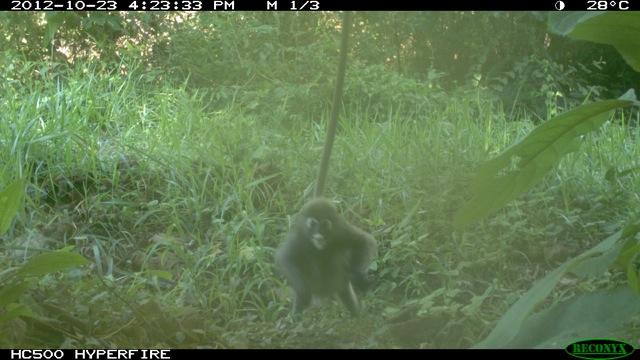
This playful dusky leaf langur (Trachypithecus obscurus), which was caught on a camera trap in the Kenyir Wildlife Corridor last week, was all smiles probably because it knew of some good news coming our way. WHAT IS IT??
The first piece of good news is that the Terengganu state government has decided to freeze development along the Kuala Berang highway bisecting the proposed Kenyir Wildlife Corridor, pending recommendations from environmental consultants working for the federal government. These recommendations are to be submitted by the end of the year.

This decision was reached after we shared our research findings in Kenyir with Dato’ Toh Chin Yaw, Terengganu Chairman of Industry, Trade and Environment Committee, Terengganu State Government. Many thanks to Dato’ Toh for sharing the pictures and videos of Kenyir’s biodiversity with other government officials. Yesterday, this piece of great news was covered by a local news portal, fz.com.

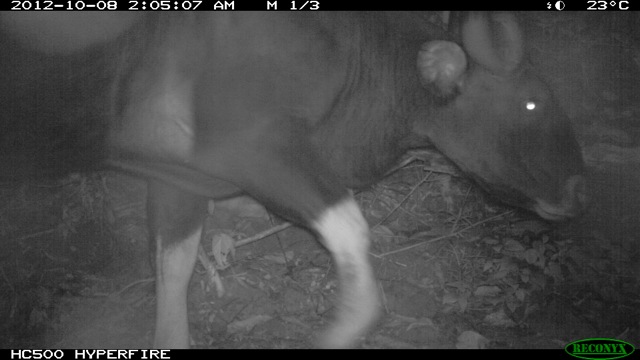
The second piece of good news is that we finally got a  camera-trap picture of the elusive seladang or gaur (Bos gaurus) after 2 years of fieldwork in the Kenyir Wildlife Corridor! We only recorded a single individual, which was detected by two separate cameras.

Although we still have a lot to do to secure protection for the Kenyir Wildlife Corridor, we are working closely with the state government to implement our recommendations. For now, we would like to extend our deepest gratitude to the wonderful people who have supported the Kenyir Wildlife Corridor project. Special thanks also go to Anuar McAfee for helping and working with us on this (Anuar also helped us get the flying foxes protected). Stay tuned for more updates!

* Update 8 November 2012: More extensive coverage, from the very excellent Mongabay: click here!