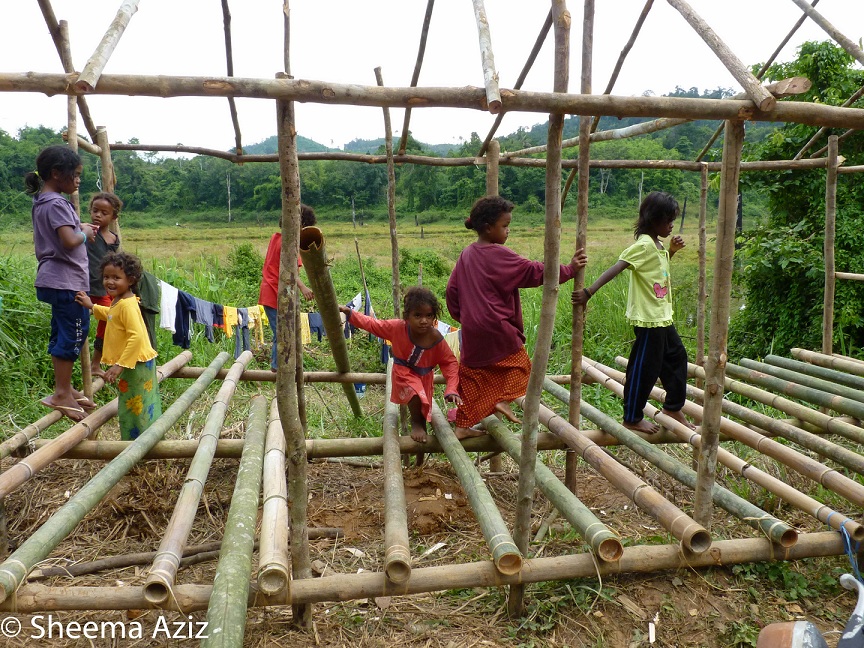
There was a time when people used to think that saving the environment was all about – well, the environment. Some people even confused it with ‘saving the trees’, ‘saving the animals’, or ‘saving wildlife’. Many conservationists nowadays know better. We’ve learnt that the environment has been shaped and nurtured by the many indigenous and local people who revere it, care for it and ultimately depend on its resources for their survival. Focusing on saving the environment, or wildlife, alone is meaningless if we don’t take into account the forest-dependent or sea-dependent peoples who are critical in ensuring nature’s well-being – and for whom, in turn, nature is a critical part of their lives. Sometimes they can be a part of the problem, but often they can be part of the solution too. This is why more conservationists need to start recognising the important role played by indigenous peoples in conservation, and also start considering and incorporating indigenous peoples in conservation efforts.
While this is now being done to some extent in most conservation projects these days, there are times when it doesn’t go beyond mere lip service conveniently dressed up as ‘consultation’ or ‘outreach’. Conservationists need to recognise that we also have a role to play when laws on managing and regulating natural resource use may affect indigenous rights. As modern nation-states have marginalised, ignored or even abused indigenous peoples – even in the name of conservation! – many of these laws completely bypass them and fail to take their input and well-being into account. This needs to change.
This issue is discussed in the latest paper by Sheema, co-authored with Reuben and former colleagues from WWF-Malaysia, Mark Rayan Darmaraj and Preetha Sankar. It was published in the journal Biodiversity and Conservation. If you don’t have a subscription, you can download the paper here:
This work was carried out as part of projects under WWF involving Orang Asli communities of Peninsular Malaysia. It gave us many invaluable insights and realisations, which is why we felt it was important to write it up and disseminate it. We are grateful that we were able to come to these conclusions thanks to the opportunities WWF gave us to work on policy, protected area management, tiger conservation, and local communities.
*Please note – due to proofing mistakes made by Springer, there are citation errors on pages 651 and 652. On pg 651, the citation ‘Azrina et al. 2011’ should instead be ‘NST 2010’. On pg 652, the citations ‘Gill et al. 2009; Hood and Bettinger 2008; Jaringan Orang Asal SeMalaysia 2010d’ should be followed by ‘Nicholas 2005’. The original citations are listed in the References.
 Rimba
Rimba 