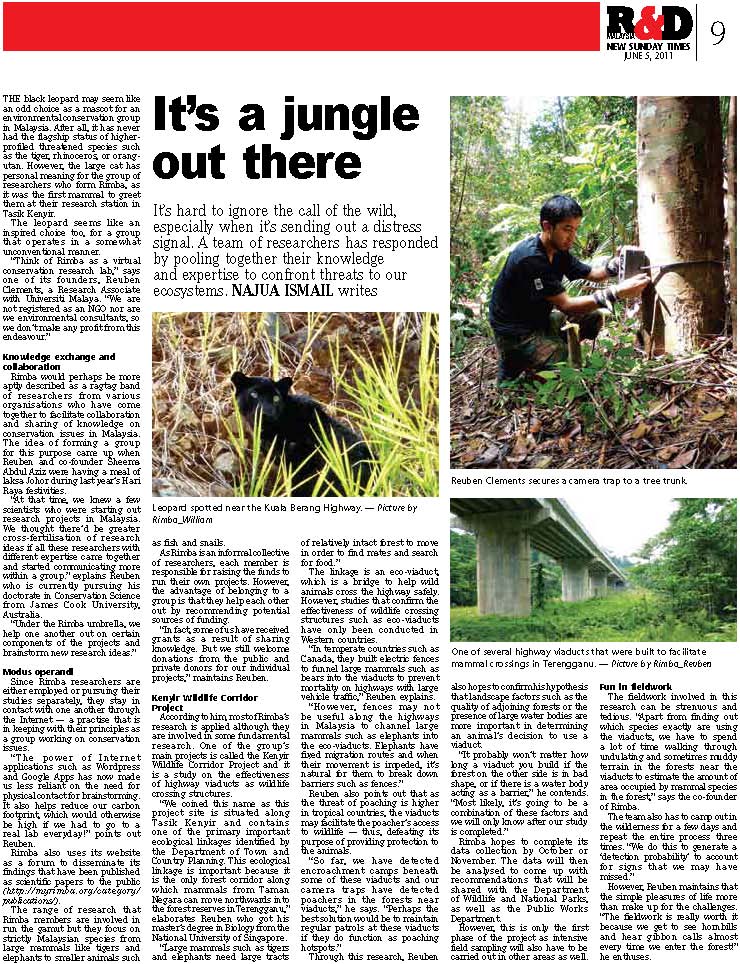
Rimba was featured in the New Straits Times on 5 June 2011! Journalist Najua Ismail was kind enough to dedicate an entire page to us in the Research & Development supplement last Sunday, providing coverage on the Kenyir Wildlife Corridor Project. Click on the image below to download and read the pdf version!
…especially when it comes to seed dispersal. Back in March, we highlighted two publications by Ahimsa which look at the role megafauna such as elephants play in shaping our forests. This time, Ahimsa’s looking at a slightly smaller – though still large – herbivore: the Asian Tapir. We’ve already mentioned before how Reuben and Sheema have been involved in a tapir population study. Ahimsa, on the other hand, has been specifically investigating tapir diet and feeding behaviour to find out if they play a role similar to that of elephants. After all, studies in South and Central America have suggested that New World tapirs might be important seed dispersers over there. But, that’s in a world where there are no elephants. So the question Ahimsa is asking is: If elephants disappear, could tapirs step in to fill their big shoes? Continue reading →
Did you know that nine species of hornbills can be found in the forests near Lake Kenyir? We’ve only seen five species so far and photographed three, but that’s only because we’ve been busy looking at the ground for mammal tracks.
Did you know that the world’s fastest bird, the peregrine falcon (Falco peregrinus), passes by Kenyir on its migratory route? It came and went so fast we couldn’t get a photo (yet)!
We’ve decided to pay tribute to the 230 bird species that have been recorded in the forests near Lake Kenyir by giving you an update of birds recorded during birding trips and mammal surveys in the Kenyir Wildlife Corridor Project.
Here are two little appetisers which show you what to expect if you visit us at our field station in Kenyir.
Great Slaty Woodpecker (Mulleripicus pulverulentus)Rhinoceros Hornbill (Buceros rhinoceros)
We welcome corrections to our identifications as we’re still fledgling birders. This is a great place for hornbill research so if you have any ideas, let’s talk! Please scroll down the list for the rest of the ‘main course’: Continue reading →


 Rimba
Rimba 