Updates to WWF Camera-trap database

Hi all!

Since Shariff Wan Mohamad from WWF-Malaysia originally posted his camera-trap database in Rimba’s Biologist Toolbox in 2012, a number of data management solutions have been developed by various researchers and organisations; some of which are freely available online. To join in the fun, he has decided to post a long overdue updated version of his camera-trap database, which he only just recently finalised. Some of the main improvements integrated into this database are listed below:

  • Added the ability to automatically fill up subsequent records of the same event based on customisable time interval between photos
  • Added a function to automatically filter records into independent events based on customisable time interval
  • Added direct output of daily capture matrix files for PRESENCE and SECR
  • Added an option to physically export good photos and photos of selected species to a folder in Windows
  • Added a more detailed user guide

You can download version 161018 of the database here.

You can also download the same database with some sample data here, to see how the outputs look like.
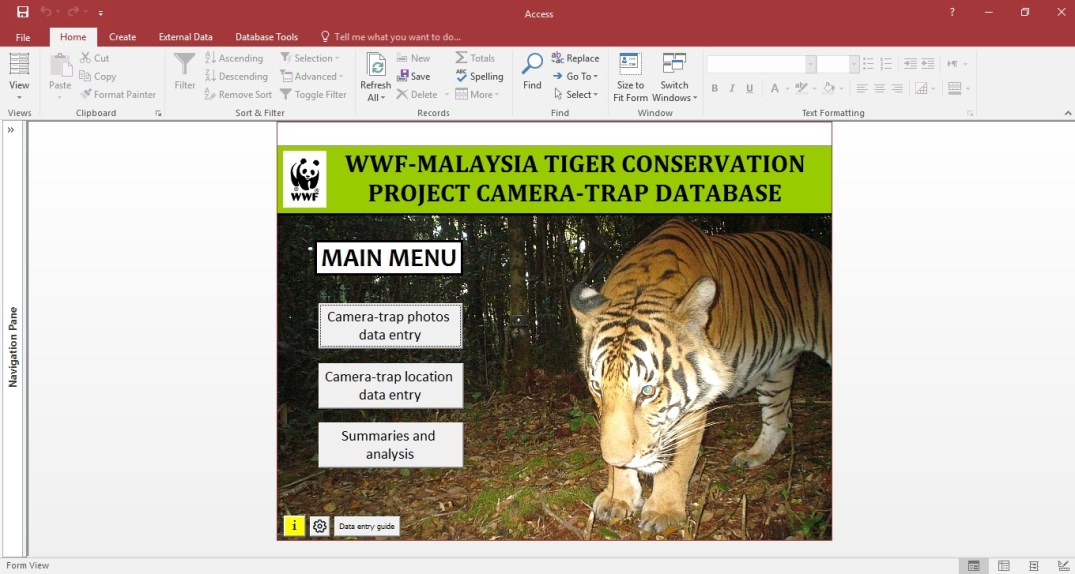
Clipboard02

Inputting data into the database is relatively simple; you only have to fill in two forms – one for camera-trap locations and one for the photo data. The results will be compiled automatically. However, make sure to read the data entry guide in the database beforehand! If your existing camera-trapping data are in MS Excel spreadsheets or a similar format, it can be imported into this database.
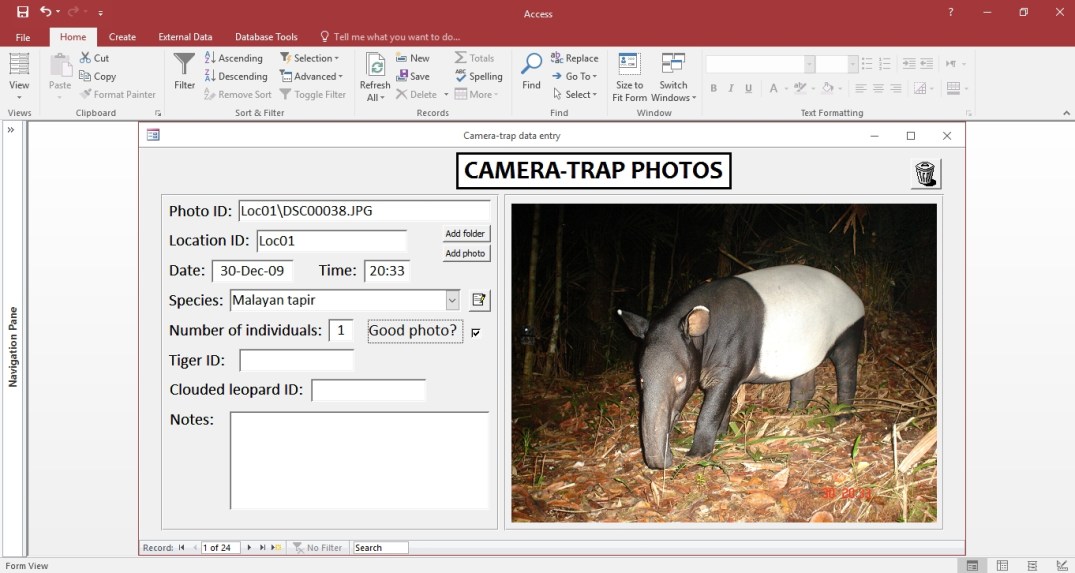
Clipboard01

Shariff won’t go into details about the summaries and analysis outputs; you can see the results for yourself in the database which contains sample data. Most of the outputs are pretty basic and easy to understand. Some of the main automated outputs are:

  • Trapping efforts
  • Distance between camera-trap locations
  • Naïve occupancy
  • Relative abundance
  • Activity patterns
  • Occupancy matrix for input into software PRESENCE
  • Data sheets for population density analysis in SECR
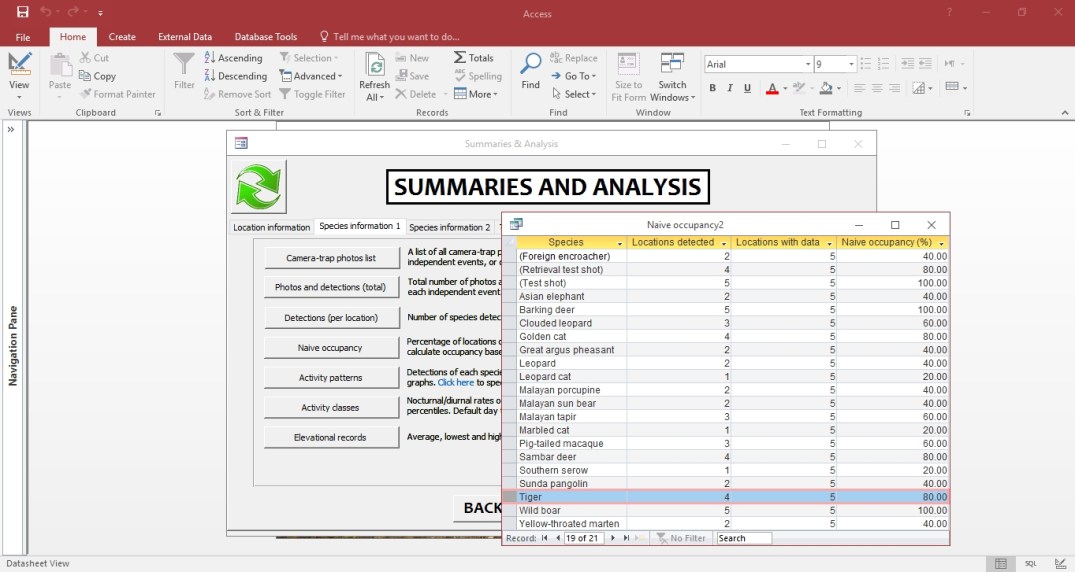
Clipboard03

As mentioned earlier, there are already a number of camera-trap database solutions currently available. Shariff recommends testing out these alternatives before deciding on which one to use, or even before choosing to develop your own. The best way to gauge which solution is best would be to input a sample of your data into the database and see what the outputs look like – then you would be able to assess whether it is suitable for your use or not.

If you don’t have MS Access the data entry can still be run via a free version called MS Access Runtime, although there are limitations in customizing or editing the database. The current version of this database was tested on MS Access 2016 (32 bit and 64 bit) on the Windows 10 platform.

Anyway that’s the general overview of Shariff’s database; if you have any inquiries then he is willing to assist in any way he can. If the results of this database are used for any publications or reports, please credit WWF-Malaysia. Hope this helps!

Shariff can be contacted at: shariff1mohamad AT gmail DOT com.

Publication update 21: Project Pteropus press release: Durian Industry May Suffer Without Endangered Fruit Bats

Flying foxes pollinate regionally important fruit crop

Kuala Lumpur, 19 September 2017 – Scientists here have discovered that Southeast Asia’s highly popular durian tree is pollinated by locally endangered fruit bats known as flying foxes.

By putting camera traps in durian trees on Tioman Island, Malaysia, researchers collected video evidence showing the island flying fox (Pteropus hypomelanus) pollinating durian flowers, leading to the production of healthy durian fruit. The study has just been published in the journal Ecology and Evolution.

Fig.3
Still shots from a video recording of a flying fox feeding on durian flower nectar.

The spiky tropical durian fruit is highly prized throughout its native region. A ubiquitous icon of Southeast Asian culture, it is also a lucrative industry, generating millions of US dollars in local and international trade. And these economic profits owe a huge debt to bats.

Commonly referred to as flying foxes, large fruit bats of the genus Pteropus are severely threatened by hunting and deforestation. They are often sold and eaten as exotic meat due to an unsubstantiated belief that consuming them can help cure asthma and other respiratory problems.

On top of this, they are also persecuted and killed as agricultural pests, as some people claim that the bats cause damage and economic loss by feeding on cultivated fruits. Consequently, these factors have led to severe declines in flying fox populations worldwide.

Yet these bats actually play very important roles as seed dispersers and pollinators in rainforests, especially on islands. The disappearance of flying foxes could thus have disastrous repercussions for tropical ecosystems. Now, this international team of researchers from Malaysia, France, India, and Thailand, in collaboration with Tree Climbers Malaysia, has found that Southeast Asia’s durian supply could be affected too. Continue reading

Project Update 22, Publication Update 20: Project Limestone Press Release

Scientists and Lafarge Malaysia Collaborate to Study Threatened Land Snails

Kuala Lumpur – Scientists and Lafarge Malaysia recently embarked on a joint study to document the diversity of land snails at limestone hills in Peninsular Malaysia.

A quarried limestone hill in Kinta Valley, Perak, Malaysia. Credit: Junn Kitt Foon. License: CC-BY 4.0

Formed from reefs beneath ancient seas, limestone hills are regarded as “arks of biodiversity” because they can harbour plant and animal species found nowhere else on Earth. A recent study showed that at least 445 limestone hills can be found scattered across Peninsular Malaysia.

Research has also shown that limestone hills provide numerous benefits to humans, by storing groundwater, or providing habitat for cave bats that either pollinate commercially important trees like Durian, or reduce pests in rice fields.

To support the construction industry which plays a vital role in the socio-economic development of the country, however, certain limestone hills are being quarried to make cement. Continue reading